


How Does ECU Tuning Work on Modern Cars?
- Torxtuning

- Jun 7
- 6 min read
Press the accelerator in a modern car and you are not just opening a throttle body or asking for more fuel. You are sending a request to the ECU. That is why one of the most common questions we hear is, how does ecu tuning work? The short answer is that tuning changes the software strategy inside the engine control unit so the car can deliver more power, more torque, sharper response, or better efficiency within safe limits.
The important part is that ECU tuning is not magic and it is not guesswork when done properly. A modern calibration is built around maps, limiters, sensor feedback and protection strategies. The result can be a car or van that feels stronger, smoother and more usable every day, often without a single mechanical part being changed.
How does ECU tuning work in practice?
Your ECU is the computer that controls how the engine runs. It processes data from sensors across the vehicle, including boost pressure, air temperature, fuel pressure, throttle position, exhaust readings and engine speed. Using that information, it decides how much fuel to inject, how much boost to request, when to adjust ignition timing and how aggressively to limit torque.
From the factory, manufacturers do not always set these calibrations for maximum performance. They have to account for different fuel qualities, climates, emissions targets, fleet requirements, gearbox limits, regional regulations and wide production tolerances. That leaves room in many vehicles for a better-balanced software setup.
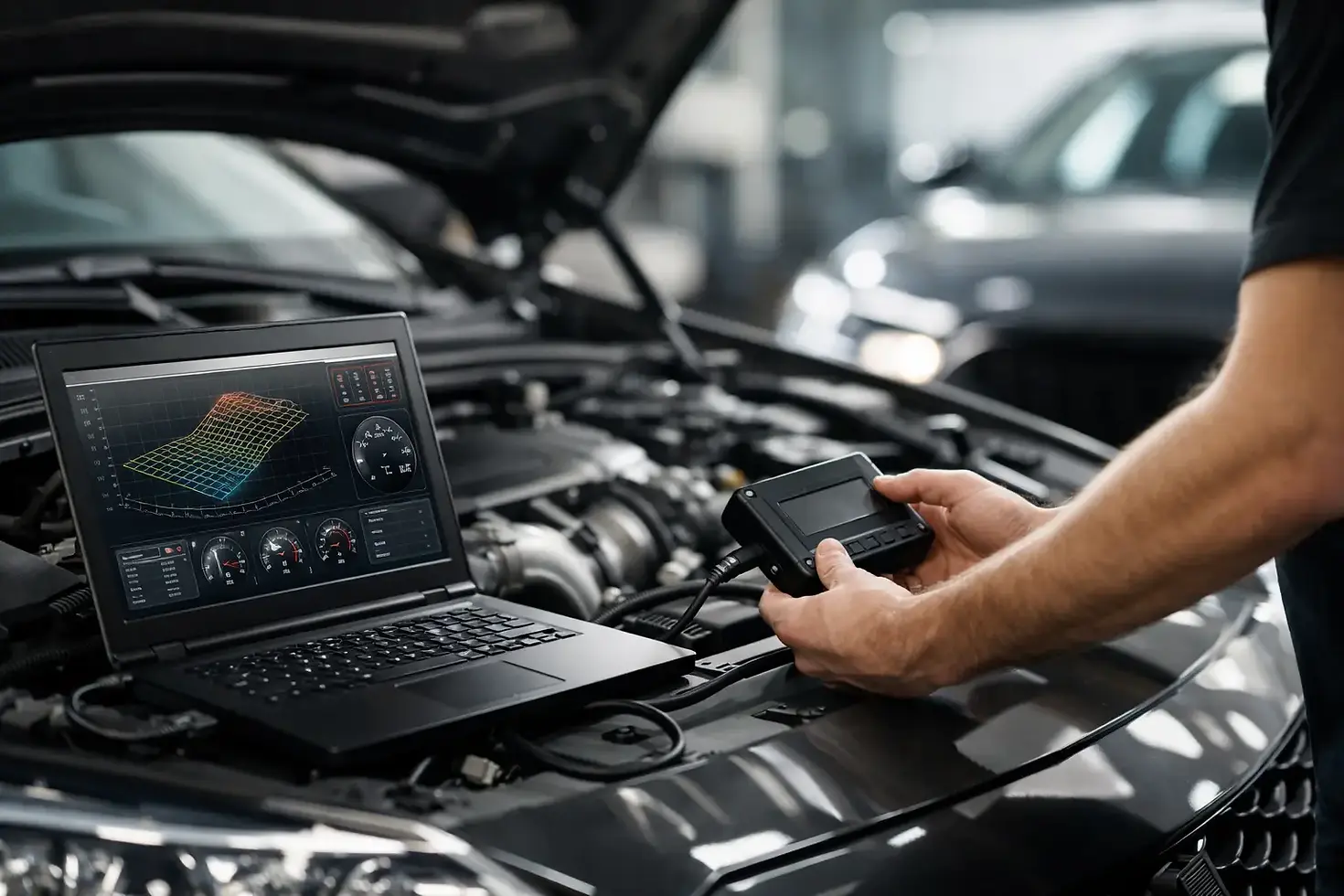
ECU tuning works by reading the original file from the vehicle, adjusting the relevant calibration data, and writing the revised software back to the ECU. On some vehicles this is done through the OBD port. On others, especially newer protected ECUs such as Bosch MD1 and MG1, bench or specialist access methods may be required.
What changes depends on the vehicle and the goal. A stage 1 road car tune might adjust boost target maps, torque limiters, driver demand maps, fuel delivery and ignition timing. A diesel van tune may focus more on low-down torque, throttle sensitivity and economy in the useful rev range. Gearbox software can also be tuned to match the new engine output, improving shift strategy and torque handling where supported.
The maps that matter most
People often talk about a remap as if there is one single power setting hidden in the ECU. In reality, there are many tables and strategies interacting with each other. The tuner is not just adding fuel and hoping for the best.
Driver demand maps define how the vehicle responds to accelerator input. Torque limiters control how much output is allowed in different conditions. Boost maps tell the turbocharger what pressure to target. Fuel maps shape how much fuel is delivered and when. Ignition timing maps on petrol engines affect combustion efficiency, response and knock sensitivity.
Then there are the supporting systems. Temperature-based protections, smoke limiters on diesels, lambda targets, rail pressure control, airflow models and gearbox torque interventions all have to remain coherent. If they do not, the vehicle may feel inconsistent, trigger faults or perform well in one area while suffering in another.
That is why professional tuning is calibration work, not just file editing. Good software has to keep the engine running cleanly and predictably across different loads, gears and temperatures.
Why factory settings leave room for improvement
A manufacturer has one calibration to suit thousands of vehicles and drivers. That means compromise is built in from the start. The same engine may be sold in several power outputs, often with very similar hardware. In some cases, the difference between variants is heavily software-led.
There is also a clear commercial reason for conservative mapping. Carmakers need to meet emissions standards, protect components across long service intervals and allow for poor fuel, neglected maintenance and extreme operating conditions. For the average owner, that can mean the car feels flatter or more restricted than it needs to.
A well-written remap refines those compromises for real-world use. Instead of a broad one-size-fits-all strategy, the software can be tailored around the actual vehicle, its condition and the owner's priorities. Sometimes that means stronger mid-range torque for overtaking. Sometimes it means smoother towing performance, improved drivability in a loaded van, or a better balance between response and economy.
Is ECU tuning safe?
This is the right question to ask, because the answer depends on how the tuning is carried out. ECU tuning can be safe when the vehicle is healthy, the file is written properly and the calibration stays within sensible operating margins. It becomes risky when software is copied blindly, protections are removed without reason, or the car already has mechanical issues that are ignored.
A proper process starts with checking the vehicle first. Diagnostic fault codes, boost leaks, weak injectors, DPF issues, failing sensors or clutch wear can all affect the result. Tuning a car with existing faults is never the right approach. The software should suit the health and hardware of that specific vehicle.
It also matters what the owner expects. Chasing the highest possible number is not always the best route for a daily driver. A measured calibration that improves torque delivery and drivability without overstressing the turbo, clutch or gearbox is often the better long-term option. This is especially true for work vans and fleet vehicles where reliability and usable performance matter more than headline figures.
How does ECU tuning work on turbo diesel and petrol engines?
The core principle is the same, but the tuning strategy differs.
On a turbo diesel, gains usually come from optimising boost control, fuel quantity, torque request and limiter structure. Diesels respond well because they are already torque-focused and often have conservative factory settings. A good diesel tune can make the vehicle pull harder from low revs and feel far less strained under load.
On a turbo petrol, the tuner will usually work with boost pressure, ignition timing, fuelling and torque management in a slightly different balance. Petrol engines are often more sensitive to fuel quality and knock control, so the calibration has to take that into account. The result can be stronger acceleration and sharper throttle response, but the margin for poor-quality software is also smaller.
Naturally aspirated engines are different again. They can still be improved, but the gains are usually more modest because there is no turbocharger to increase airflow significantly. In those cases, tuning is more about response, smoothing out delivery and refining how the engine behaves.
What a proper tuning session should include
A professional ECU tune should not start and end with plugging in a tool. The vehicle should be assessed, the original software identified, and the right read and write method used for that ECU type. Newer vehicles with encrypted control units require more specialist handling than older platforms.
The software itself should be built around the vehicle and its use. A hot hatch used for fast road driving needs a different approach from a Transit that spends its life carrying tools. If the vehicle has gearbox software limitations, emissions-system issues or known platform-specific quirks, those have to be factored into the calibration.
After writing the file, the car should be checked again. The aim is not just more output, but clean operation, predictable behaviour and no unwanted side effects. A lifetime software warranty and proper aftercare also matter, because support after the job is part of what separates a specialist from a quick-file seller.
The trade-offs people should understand
ECU tuning is not a free pass to ignore maintenance. More torque can expose a worn clutch. A tired automatic gearbox will not become healthy because the software has changed. If you drive harder after a remap, fuel economy may drop even if the calibration itself is more efficient under light load.
Insurance is another consideration. Any performance-related software change should be declared. Depending on the vehicle, warranty position and finance agreement, tuning may also affect cover or terms. For some owners, especially those with newer vehicles, that is a practical factor worth considering before any work is carried out.
There is also a difference between maximum gains and best gains. The best tune is not necessarily the most aggressive one. It is the one that suits the engine, gearbox, fuel quality and how the vehicle is actually used.
Why expertise matters more than the tool
Plenty of companies can connect to an ECU. That does not mean they understand the calibration properly. The tool is only the access method. The real value is in knowing which maps to adjust, how those changes interact, and where the safe limits are for that platform.
That is particularly relevant on modern protected ECUs and more complex vehicles with integrated torque management across engine and gearbox systems. A generic file may work, but a well-developed calibration will usually feel cleaner, smoother and more consistent. It will also be less likely to create drivability issues, fault codes or unnecessary stress on components.
For drivers around Milton Keynes, Leighton Buzzard and the surrounding area, convenience matters too. Mobile tuning can make the process far easier, but only if the technical standards stay high. The right provider brings both - specialist knowledge and a process that gives you confidence from health check to final write.
If you are wondering whether your car or van is a good candidate, the best place to start is not with the biggest claimed gains. It is with the condition of the vehicle, what you want it to do better, and whether the software can be tailored to deliver that properly.


